EES Guest Speaker - Dr. Chad Deering
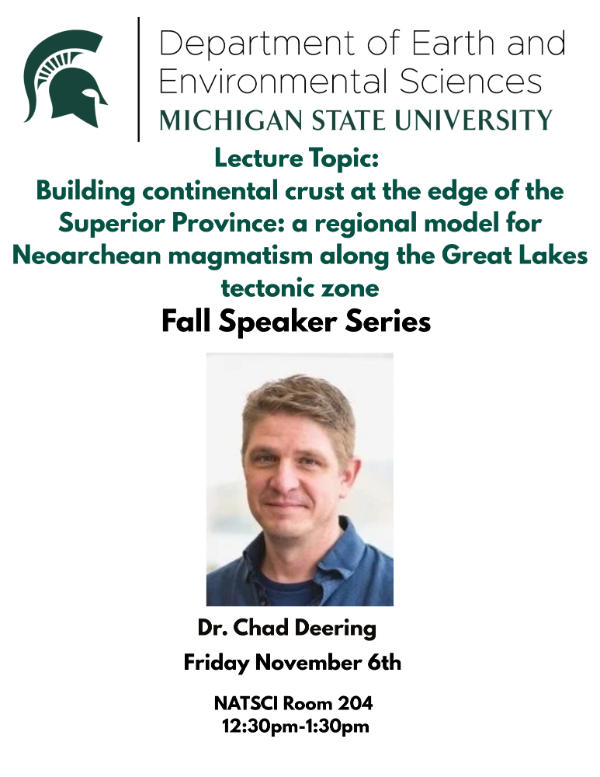
This week’s seminar speaker is Dr. Chad Deering. Please join us Friday, November 6th, 2026 at 12:30 pm in room 204 NatSci.
Talk title: Building continental crust at the edge of the Superior Province: a regional model for Neoarchean magmatism along the Great Lakes tectonic zone
Bio: Chad Deering is an associate professor in the Department of Geological and Mining Engineering and Sciences at Michigan Technological University. A volcanologist and igneous petrologist by training, his research spans the dynamics of magmatic systems in silicic caldera settings, the evolution of continental crust through deep time, and the links between magmatism and mineral systems. His current work includes the Three Lakes/Nestoria bedrock mapping project in Michigan's Upper Peninsula, part of the USGS Earth Mapping Resources Initiative. This effort includes new mapping, geochemistry and zircon geochronology, which are being used to reconstruct the Archean growth of the crust along the Great Lakes tectonic zone.
Abstract: The Great Lakes tectonic zone marks the boundary between the Superior Province and older gneiss terranes to the south, yet the Archean crust on its northern side in Michigan's Upper Peninsula is among the least studied in the region. New mapping, bulk-rock and zircon chemistry, and zircon U–Pb ages from the Three Lakes area reveal two magmatic episodes about 50 million years apart, separated by a sharp boundary across which age, chemistry and structural fabric all change. The younger episode produced two distinct suites: granite along the tectonic zone itself, and a mantle-derived sanukitoid series to the northwest that is folded together with its host and may carry a signature of gold mineralization. These results point to a model in which juvenile crust grew progressively across the area and was then intruded by mantle-sourced magmas focused along the tectonic zone during collision.